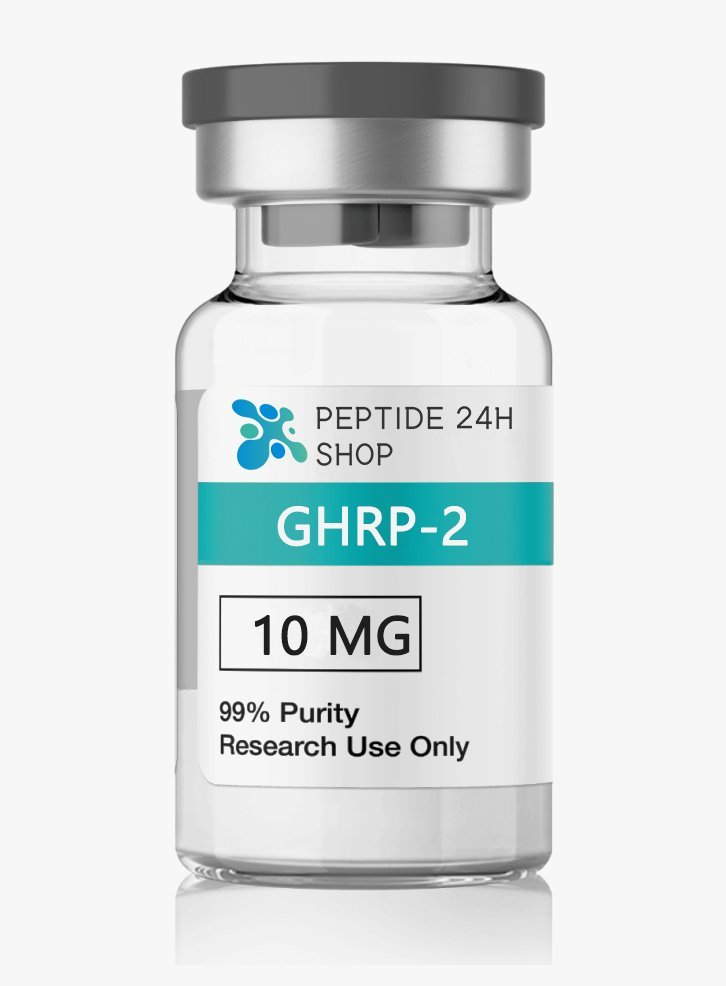
$45.00 – $270.00Price range: $45.00 through $270.00
Name: GHRP-2; Pralmorelin
CAS No.: 158861-67-7
Peptide Sequence: H-D-Ala-D-2-Nal-Ala-Trp-D-Phe-Lys-NH2
Molecular Formula: C45H55N9O6
Molecular Weight: 817.97
Appearance: White Lyophilized powder
GHRP-2, short for Growth Hormone Releasing Peptide-2, is a synthetic hexapeptide widely studied in the fields of endocrinology, peptide biochemistry, and molecular signaling. Designed to mimic natural growth hormone secretagogues, GHRP-2 is used primarily in laboratory research to explore the regulation of growth hormone (GH) release, pituitary gland signaling, and energy metabolism in model systems.
Since its development, GHRP-2 has become a key tool for understanding GHS-R1a receptor interactions and the physiological pathways associated with growth hormone–releasing mechanisms.
GHRP-2 is a synthetic peptide belonging to the Growth Hormone Releasing Peptide (GHRP) family, which includes GHRP-6, Ipamorelin, and Hexarelin. These peptides were designed to act as GH secretagogues, binding to the ghrelin receptor (GHS-R1a) and promoting growth hormone release in experimental models.
Chemically, GHRP-2 is a hexapeptide with the sequence:
D-Ala-D-2-Nal-Ala-Trp-D-Phe-Lys-NH₂
This structure gives it a strong affinity for the GHS-R1a receptor and makes it a useful research molecule for studying peptide-receptor signaling and endocrine regulation.
| Property | Description |
|---|---|
| Peptide sequence | D-Ala-D-2-Nal-Ala-Trp-D-Phe-Lys-NH₂ |
| Molecular formula | C45H55N9O6 |
| Molecular weight | ~817.0 Da |
| Solubility | Soluble in sterile water or dilute acids |
| Appearance | White to off-white lyophilized powder |
| Storage | Stable when stored at –20°C, away from light and moisture |
Its chemical stability and receptor specificity make GHRP-2 suitable for controlled in vitro and in vivo studies on hormonal pathways.
GHRP-2 functions as a growth hormone secretagogue that stimulates GH release through two primary pathways:
Activation of GHS-R1a (Ghrelin Receptor):
GHRP-2 binds to the growth hormone secretagogue receptor in the pituitary and hypothalamus, promoting GH secretion via calcium-dependent signaling cascades.
Modulation of the Hypothalamic–Pituitary Axis:
The peptide has been shown in experimental systems to affect neuroendocrine feedback loops involving GH, GHRH, and somatostatin.
These dual actions make GHRP-2 a powerful molecule for studying endocrine signaling, receptor pharmacology, and peptide-mediated regulation.
Additionally, research has explored its influence on IGF-1 expression, metabolic processes, and appetite regulation, although these effects remain under investigation in preclinical settings.
Because of its well-characterized action on GH release, GHRP-2 has been widely used in:
Endocrine system studies: To investigate pituitary gland function and GH regulation mechanisms.
Signal transduction research: For examining peptide-receptor interactions via the GHS-R1a receptor.
Pharmacological testing: As a model for GH secretagogue analog development.
Aging and metabolism studies: Exploring GH-related pathways in cellular and animal models.
Comparative peptide research: Studying receptor affinities among GHRP family peptides.
Its high specificity and predictable receptor activity make GHRP-2 a benchmark peptide for endocrine signaling research.
To preserve peptide integrity and ensure reproducible results, GHRP-2 should be handled with care:
Store lyophilized peptide at –20°C or colder.
Reconstitute using sterile water or bacteriostatic saline immediately before use.
Avoid repeated freeze-thaw cycles.
Handle under sterile laboratory conditions to prevent contamination.
When properly stored, GHRP-2 maintains stability for months to years, depending on formulation and storage environment.
GHRP-2 is classified strictly as a research-use-only peptide. It is not approved for human or veterinary use, diagnostic applications, or therapeutic purposes.
Researchers must follow institutional biosafety standards and regional regulations when handling GHRP-2 or related compounds. Appropriate use of personal protective equipment (PPE) and good laboratory practices (GLP) are essential.
Q: What does GHRP-2 do in research?
A: GHRP-2 is used to study GH secretion, receptor binding mechanisms, and peptide signaling pathways.
Q: Is GHRP-2 similar to GHRP-6?
A: Both are GH secretagogues but differ in potency and receptor selectivity. GHRP-2 generally exhibits stronger receptor binding affinity.
Q: Can GHRP-2 be used in humans?
A: No. GHRP-2 is intended only for laboratory research and not for medical or clinical use.
Q: How is GHRP-2 stored?
A: Keep lyophilized peptide at –20°C and reconstitute prior to experimental use. Avoid light and moisture exposure.
GHRP-2 (Growth Hormone Releasing Peptide-2) remains a cornerstone compound in peptide and endocrine research. Its predictable activity on the GHS-R1a receptor and GH signaling pathways provides valuable insights into pituitary regulation, receptor dynamics, and growth hormone physiology.
For scientists, molecular biologists, and peptide researchers, GHRP-2 continues to serve as a foundational model for understanding peptide-based hormone modulation and receptor pharmacology — a vital step toward uncovering the complexities of cellular communication.